Written by
Marketing Team
August 28, 2026
.png)

Between work, travel, family, social commitments, and everything else on the calendar, finding time for exercise can feel impossible. But what if an effective workout didn’t require an hour or even a gym?
Sometimes, just 10 intentional minutes are enough to keep you moving, build consistency, and create a meaningful stimulus for your body.
That was the focus of BLU’s recent "Tight on Time Workout Workshop", where our trainers explored one simple question: What is really standing between you and a consistent exercise routine?
When it comes to exercise, the barriers are often more familiar than we realize:
The good news? Most of these barriers have practical solutions.
1. “I Don’t Have Enough Time.”
You don’t necessarily need a full workout hour to move your body.
A focused 10-minute session can be enough to create an effective training stimulus when you use your time intentionally. The goal isn’t to make every workout longer. It’s to make the time you have count.
One useful tool is time under tension (TUT): the amount of time your muscles spend working during an exercise. By manipulating tempo, repetitions, rest periods, and movement duration, you can change the stimulus without adding more equipment or more time.
Another strategy is an AMRAP, or “as many rounds as possible,” where you complete a set of exercises for a defined amount of time.
The clock becomes part of the workout.
2. “I’m Too Tired to Exercise.”
It’s easy to assume you need energy before you exercise. Sometimes, movement can actually help create it.
That doesn’t mean every workout should be high intensity. The appropriate level of effort depends on your goals, your fitness level, and how your body is feeling that day.
Sometimes the right choice is a challenging workout. Other times, it’s a walk, mobility session, or lower-intensity movement.
The important thing is to keep moving consistently.
3. “I’m Afraid of Getting Hurt.”
Exercise should challenge you without compromising your safety.
You don’t need complicated movements to get results. Start with the basics: controlled squats, push-ups, walking, mobility, and other foundational movements.
And remember, exercises can be modified. A push-up can be performed against a wall or from the knees. A squat can use a smaller range of motion. You can even replace repetitions with a short isometric hold, such as holding a squat position for 10 seconds.
The goal is not to force your body into a movement it isn’t ready for. Work within a pain-free range and progress at your own pace.
4. “I Don’t Have Equipment.”
You may be surprised by how much you can accomplish with nothing more than your own body.
Bodyweight exercises can challenge strength, muscular endurance, balance, coordination, and mobility. Equipment can certainly add variety and resistance, but it isn’t always necessary for an effective workout.
Your body can be the starting point.
An effective workout isn’t defined simply by how long you exercise or how much equipment you use.
It comes down to the stimulus you create. Consider three important factors:
Time: How long are your muscles working?
Effort: How challenging is the movement for you?
Intensity: How hard are you working relative to the session's goal?
This is also where understanding different types of training matters. For example, a Zone 2 session is intentionally performed at a lower intensity and serves a different purpose than a short, high-effort AMRAP.
There isn’t one intensity that is right for every workout.
The key is knowing why you’re doing what you’re doing.
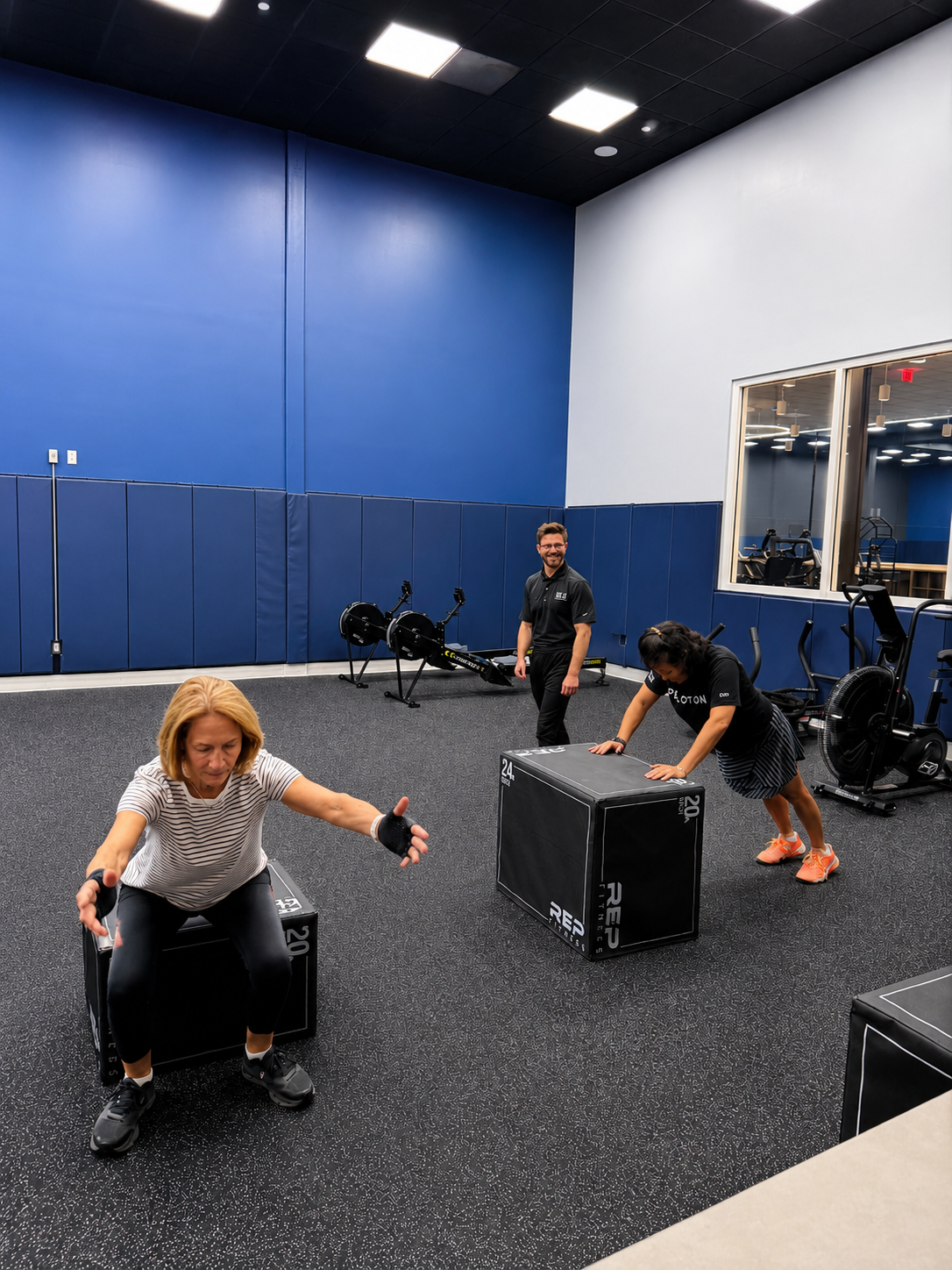
During the Tight on Time Workshop, members put these principles into practice with a simple 10-minute AMRAP.
The workout consisted of:
Squats + Push-Ups
For 10 minutes, participants completed as many quality rounds as they could, working at their own pace.
The challenge created a little friendly competition, but the priority remained the same: safe, effective, and enjoyable movement.
And that’s an important lesson.
You don’t need to move as fast as someone else. You don’t need to complete the same number of repetitions. Your workout should meet you where you are.
If traditional push-ups aren’t appropriate for you, try wall push-ups or knee push-ups.
If a full-depth squat isn’t comfortable, reduce your range of motion.
If repetitions aren’t right for you that day, try a controlled squat hold instead.
The objective isn’t to prove how much you can do. It’s to find a version of the movement that allows you to participate safely and consistently.
A packed schedule, a vacation, or a lack of equipment doesn’t have to completely interrupt your routine.
Ten minutes of intentional movement is better than deciding that if you can’t complete a full workout, there’s no point in starting.
The next time you find yourself saying, “I don’t have time to exercise,” try asking a different question: “What can I do with the 10 minutes I have?”
Because when it comes to building healthier habits, sometimes the biggest change starts with simply making time to move. We believe movement is an important part of a comprehensive approach to health, wellness, and longevity, and it should be something you can incorporate into your life, not something that adds stress to it.


Get the latest from trusted physicians, fitness experts, and wellness leaders covering everything from cutting-edge longevity science to simple, actionable tips to stay strong and vibrant.



.png)